Trento strengthens its role as an international hub for FLASH radiotherapy research
Friday, 14 August 2026
For three days, Trento became an international meeting point for scientists working at the forefront of one of the most promising future developments in radiation oncology: FLASH radiotherapy. More than simply hosting the 4th FLASH Workshop – "The Role of Oxygen and Beyond in the FLASH Radiotherapy Mechanism", the city demonstrated how a unique combination of scientific excellence, advanced technology and clinical expertise is creating an ecosystem capable of accelerating the translation of FLASH radiotherapy from laboratory research to future patient care.
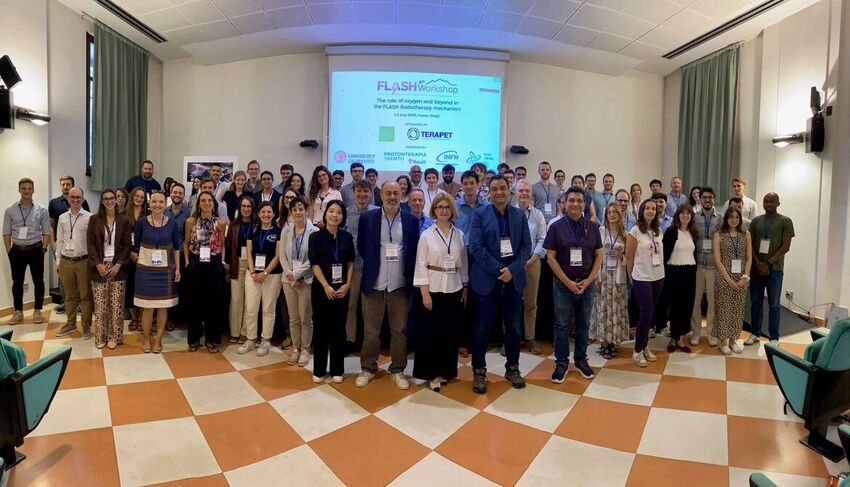
The workshop, jointly organized by the University of Trento (UniTrento), INFN-TIFPA and the Trento Proton Therapy Center of ASUIT, brought together internationally recognized experts in radiation biology, medical physics, oncology and particle therapy to discuss the latest advances in understanding the biological mechanisms responsible for the FLASH effect.
Unlike conventional radiotherapy, FLASH delivers the therapeutic dose in milliseconds using ultra-high dose rates. Experimental studies have consistently suggested that this approach may substantially reduce unwanted effects on healthy tissues while maintaining tumour control. Explaining why this happens—and how it can be safely translated into clinical practice—has become one of the most active areas of research in radiation oncology.
Trento offers a particularly favourable environment to address this challenge. Fundamental physicists, radiation biologists, medical physicists, engineers and clinicians work side by side, combining complementary expertise that is rarely available within a single scientific ecosystem. Throughout the workshop, researchers presented new experimental and theoretical results on oxygen depletion, radiation chemistry, beam delivery, dosimetry and biological response, contributing to a deeper understanding of the mechanisms underlying the FLASH effect.
The collaboration between INFN-TIFPA, the University of Trento and ASUIT also represents an important opportunity for future clinical translation. By integrating fundamental research with one of Europe's most advanced proton therapy facilities within the framework of decade-long excellence in clinical photon and proton radiotherapy, Trento is helping build the scientific foundations required before FLASH therapy can become part of routine clinical practice.
The timing of the workshop further highlighted the rapid evolution of the field. During the same days, the final preparations have begun at University of Pennsylvania to launch the first clinically meaningful human FLASH trial, using the same technological proton therapy platform installed in Trento. While many scientific questions remain to be answered, this milestone illustrates how rapidly FLASH research is progressing from experimental investigation toward carefully designed clinical evaluation.
The discussions held in Trento confirmed that answering the remaining biological and technological questions will require precisely the type of multidisciplinary collaboration that has become the hallmark of the Trentino research community.
As the workshop concluded, one message clearly emerged: the future of FLASH radiotherapy will depend not only on technological innovation, but also on the ability to connect physics, biology, engineering and medicine. Trento has established itself as one of the places where this integration is already taking place.
Via Al Desert n.14, 38123 Trento
MAIL:
protonterapia@apss.tn.it
TELEPHONE:
+39 0461 1953100
HOURS: Lun - Ven | 8.30 - 16.00